

We’ve all seen them – famous celebrities, well-known socialites, politicians, people of wealth and power – with horrible facelifts. With all their resources and connections, how is that possible? And if these people end up with horrible results… well… it makes one nervous when considering a facelift. Why do celebrities and people of means end up with bad facelifts?
I trained with a very famous plastic surgeon – Dr. Bruce Connell – acknowledged as one of the finest facelift surgeons of the 20th century. Practicing in Southern California, his patients were a true who’s who in Hollywood, fashion, national politics, and business. Now retired, in the 1970’s, 80’s, and 90’s, he developed the techniques that are now considered the state-of-the-art. His work in defining the neck and jawline, creating a long-lasting natural result, is required reading for every plastic surgeon who aspires to become a true master of facial rejuvenation.
Dr. Connell and I had many discussions about what makes a great facelift, which I will blog about in the next few months (Hint: After you learn the advanced techniques, develop the advanced skills, and obtain the excellent judgment that comes with deep experience, you’re essentially guaranteed to obtain a good facelift. But good is not the goal. To get consistently great results, you need to focus on the details! More to come!)
Over the year I worked closely with Dr. Connell, learning his techniques and approach to facial rejuvenation, we only created wonderful results, and many were on celebrities. These were household names, and they were all very thankful. However, even in the 1980’s – bad celebrity facelifts were common. I once asked Dr. Connell why that happened. He thought for a moment then said “Three reasons. First, flavor of the month. Second, enough is never enough. Third, listening to the wrong people.”
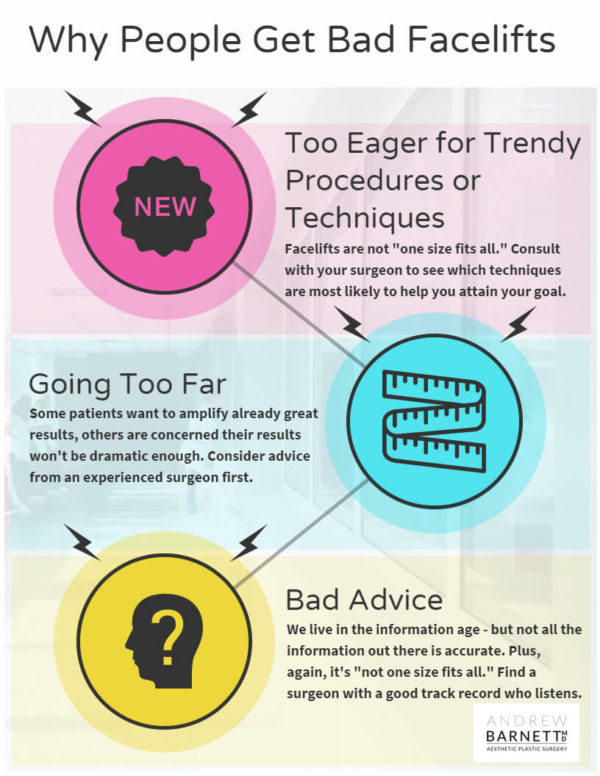
Flavor of the Month
It’s natural to want the latest and the greatest. The hot new surgeon, the brand-new techniques, the latest equipment. How often do you get a facelift? Who wants to think that they missed something new and spectacular? In the next blog we’ll look at some examples of how that philosophy can go wrong and how to separate cutting edge from bleeding edge (no pun intended).
Enough is Never Enough
Who hasn’t eaten a great meal where the food is rich, tasty, and, well… spectacular. And who, in that situation, at one time or another, has failed to exercise appropriate judgment. The result? You go home stuffed, nauseated, and regretting your lack of control – “It would have been great if I’d just stopped after that first serving of pasta, the first piece of cake, and let’s not talk about the cocktails…” It happens with plastic surgery as well. In another blog I’ll discuss some well known examples and how to know when enough is enough.
Listening to the Wrong People
In the old days, when you were interested in finding a new doctor, financial advisor, or attorney, you did your homework. You asked people you trusted, you looked for reliable sources. Things have changed. It’s really easy to get lots of information from well meaning friends, the internet, and from social media. But how good and how reliable is that information? Are you listening to the wrong people? In another blog I’ll provide you with an approach which will give you insight and tools on deciding who to listen to, and who to ignore.
Good is not the goal – great is the goal.

